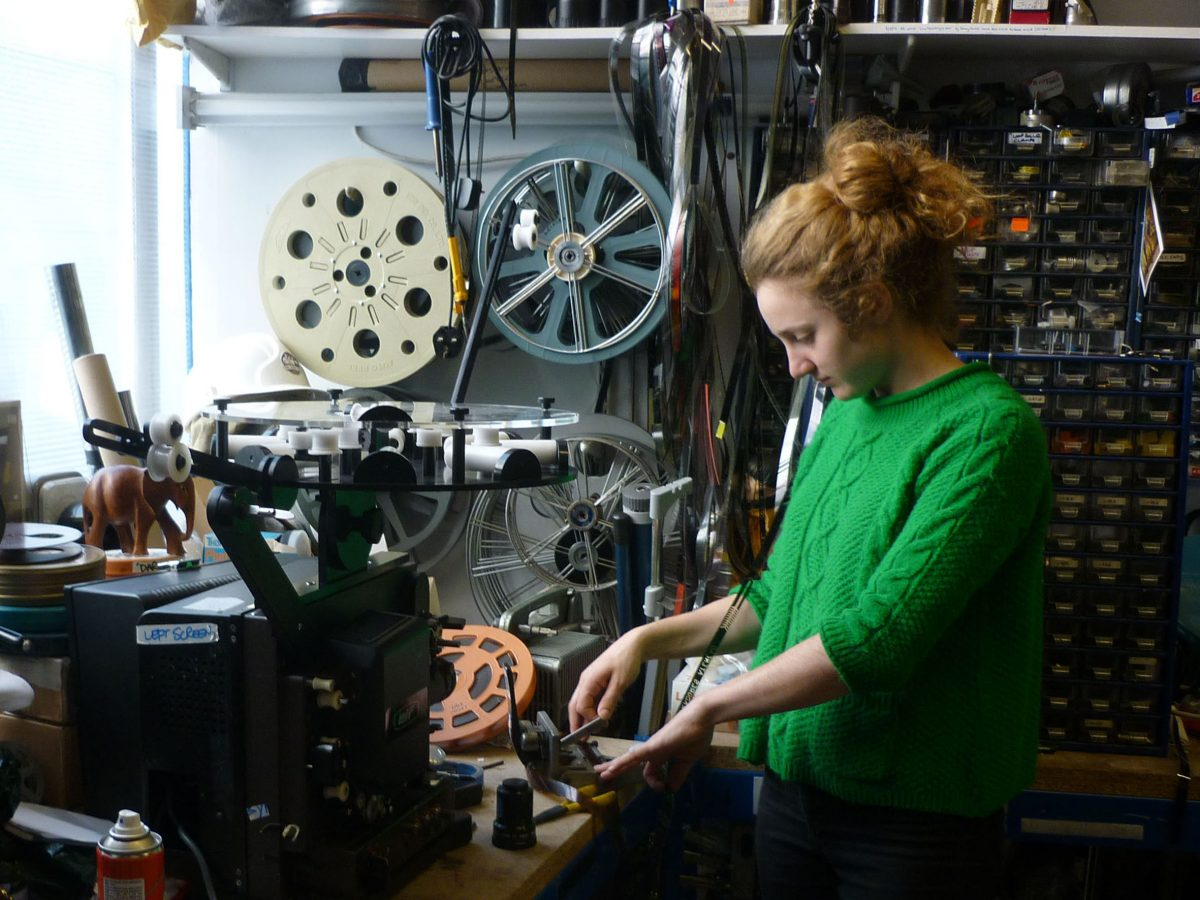
Sophie Michael is a London-based artist whose work transcends genres, blending filmmaking, sculpture, and installation into a unique creative language. Her 16mm films and gallery spaces immerse viewers in a dialogue between the past and present, exploring nostalgia, hidden memories, and the cultural codes of the 20th century. Read more on london-trend.
Early Years and Creative Journey
Born in London in 1985, Sophie Michael began her artistic career at the Slade School of Fine Art, where she studied sculpture. It wasn’t until her final year of her bachelor’s degree that she first turned to film, experimenting with 35mm slides. During her postgraduate studies at the Royal Academy of Arts, she began creating installations using materials from educational films from the 1960s and 70s and DIY home improvement manuals. For months, she would collect and arrange these objects, gradually building environments that would later become the sets for her film projects.
In 2010, Michael presented one of her first major films, “99 Clerkenwell Road.” Shot at night on 16mm film in an empty shop, it was a subtle nod to the work of German animator Oskar Fischinger. Using items left in the space — lights, columns, and roller shutters — she merged abstraction with the perception of real space. In this film, she aimed to reveal architecture as a living organism, transitioning from a flat plane to a three-dimensional volume, from the abstract to the tangible.
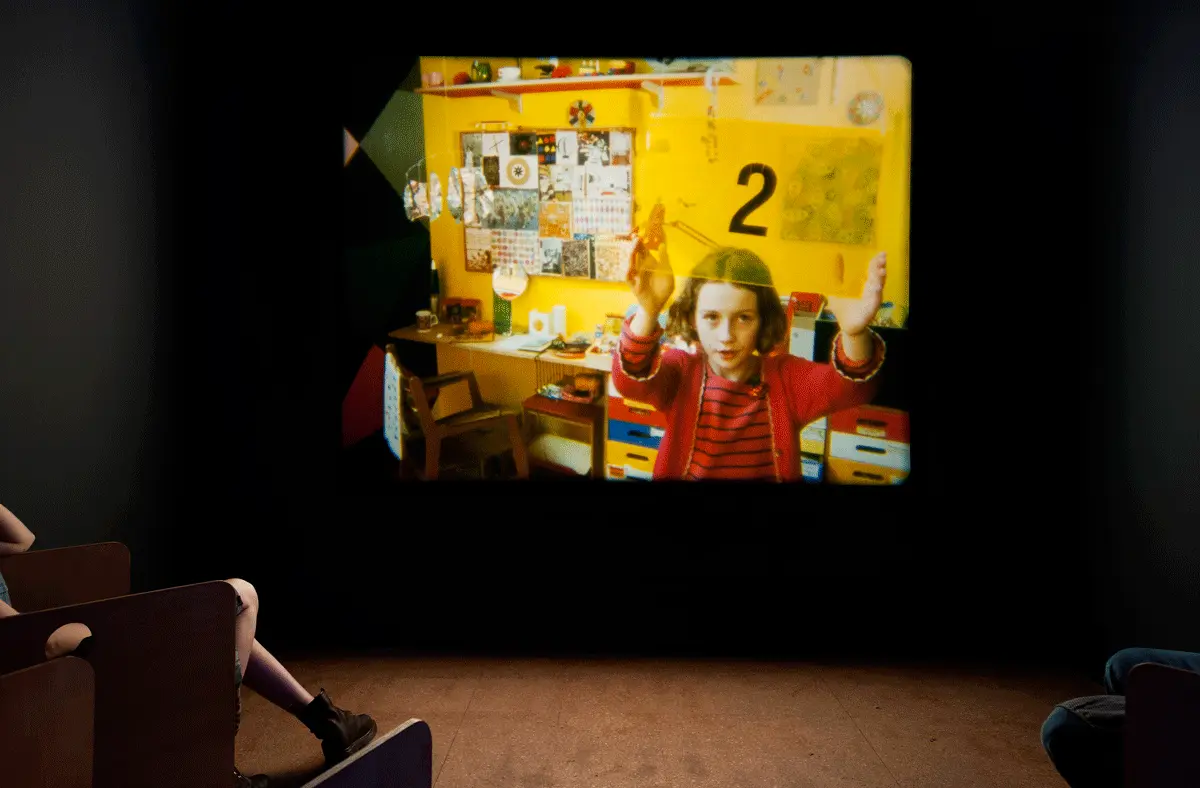
During her final years of study, Michael began work on the “Astrid” series (2010–2014), which would become one of the most celebrated projects of her career. The film “Chapters One to Five” holds a special place within the series, featuring Astrid Everall, who the camera followed from the age of seven to eleven. It consists of five shots, or “chapters,” each revealing a distinct space meticulously constructed by the director. She spent six months building the sets, collecting items that referenced the idealised middle-class lifestyle of the mid-20th century, including 1950s advertisements, 1970s DIY guides, and the exhibition plans of Charles and Ray Eames.
In her later work, Sophie Michael increasingly explored the theme of the modern human’s relationship with the past. “The Watershow Extravaganza” (2016) is a prime example of this approach. Inspired by an attraction of the same name at Watermouth Castle in North Devon, the original show, built for the 1951 Festival of Britain, combined water, light, and music. Michael recreated this experience in her film, capturing the shifting colours of water and light accompanied by the sound of a 1920s mechanical organ.
In 2021, Michael debuted “Rabbit Hole,” a work that marked a new intersection of experimental abstraction and the theme of child language. The visual foundation consists of collages on sugar paper, which recreate the patterns of “chromatropes,” a nod to early cinematic experiments. A particularly poignant element of the work is the voice of the artist’s three-year-old son. He talks to himself, trying to create new combinations of words to describe a mysterious place in a room filled with origami rabbits. His phrases appear on screen at the centre of the patterns, combining the intimate process of language acquisition with experiments in moving images.
Recognition and Significance
Sophie Michael holds a prominent place in the contemporary British art scene, blending film, photography, and sculpture into a unique creative language. Her work is distinguished by its technical excellence and visual richness, exploring complex themes of cultural memory, abstraction, and new forms of animation. A significant aspect of her career has been her collaboration with the Kino Club, a leading platform for showcasing 16mm films in the UK and beyond. Through this partnership, the artist has gained experience in working with the unique needs of galleries, museums, and independent cinemas, mastering the art of safely presenting both contemporary and historical works.