


The history of cinema development in London is very eventful, interesting and exciting. This city gave the world many talented actors and other representatives of the film industry. Moreover, the history of many locations in the city can tell us about the development of this sphere as well. One of them is The Screen on the Green. It is a small cinema, which has become one of the gems of the city. The history of its existence allows us to trace cinema evolution in the capital of Great Britain. This place can’t be called majestic and refined, but its incredible atmosphere makes you come back there again and again. What is the history of its creation and development? Why is the cinema an important object in the modern city? What are its main features? Learn more at london-trend.
EVERYTHING STARTED WITH AN UNUSUAL IDEA
In general, The Screen on the Green is one of the oldest cinemas not only in London but also in the whole of Great Britain. Its history began with the two Pesaresi brothers. At the beginning of the 20th century, they impressed people with their interesting and unusual cartoon shows. It was something new and modern at that time. Therefore, it attracted the attention of society at a very fast pace. After some time, a whole cinema appeared in the borough of Islington. The local old shops were demolished and the new theatre was built according to the project of architects Boreham & Gladding.
FURTHER DEVELOPMENT AND NUMEROUS NAMES
The theatre was created in October 1913. Then it was called The Empress Electric Theatre. At the beginning of its existence, the cinema was very popular. Thanks to its uniqueness and innovative ideas, it was often compared to the most famous institutions in London. Reviews of The Empress Electric Theater were generally positive. However, its development stalled somewhat around the end of the 1930s. Accordingly, the popularity of the cinema decreased as well. This place needed a makeover. The cinema opened after a long reconstruction in 1951. Such transformations not only contributed to the formation of a light atmosphere inside but were also associated with a change of the name. Then the place became known as The Rex. Although the number of seats was reduced during the restoration, the cinema began to bloom little by little again. In the 1960s, the cinema screened films in the original language, including Greek and Turkish. That experiment was quite interesting and forever etched in the history of the cinema. However, despite some success, the place closed its doors in June 1970. Fortunately, the closure wasn’t permanent and the cinema reopened in September of the same year. It was acquired by Mainline Pictures Group and named The Screen on the Green. About ten years later, the cinema underwent restoration. Most importantly, it acquired a foyer, which never existed in the original building. However, it led to a decrease in the number of seats.
CURRENT STATE OF THE VENUE
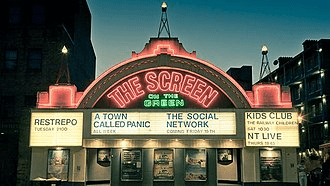
The Everyman Media Group bought this place in a more modern period of cinema history. It happened in 2008. The institution was renovated the following year. This modernisation involved the creation of a large bar and stage, which provided the opportunity to host a variety of live events in the building. Nowadays, The Screen on the Green not only shows popular films but also hosts concerts. In general, the cinema is a small and cosy place. Thanks to its creative atmosphere, people come back there to watch films again and again, while the beautiful area around provides an opportunity to take a walk afterward.