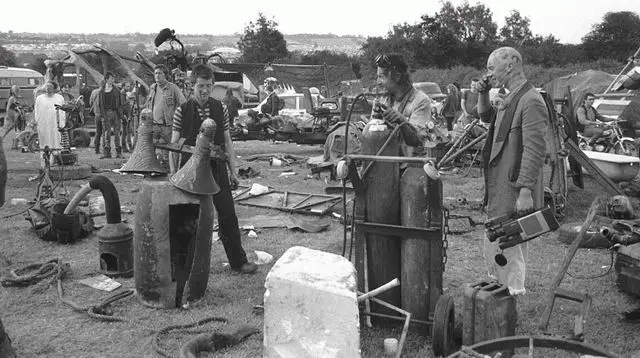
From the wreckage of old cars, rusty engines, and broken machinery, they forged giants that came alive to the rhythm of rave music. The Mutoid Waste Company carved a path for art without borders. Their apocalyptic installations didn’t just shock audiences; they helped shape a new aesthetic, where the ruins of the industrial world became potent symbols of freedom and rebirth. Read more on london-trend.
The Founding and Evolution of Mutoid Waste Company
In the late 1970s, a young Joe Rush was on a quest to find his own artistic voice. Lacking any formal art education, he honed his craft over five years in an acquaintance’s stage design workshop, learning to work with a diverse range of materials. Concurrently, the enthusiastic artist was creating his own pieces at the Gentle Ghost studio in Shepherd’s Bush — an old funeral parlour that became the hub for his initial experiments. It was there that his first ‘Mutoid’ sculpture was born.
In 1983, fate introduced the young man to mechanic Robin Cooke. They were united by a shared passion for experimentation and a desire to create work that transcended the confines of traditional art. This collaboration blossomed into the fully-fledged Mutoid Waste Company in 1984. Their work mashed together the aesthetics of punk, industrial art, and the anarchist spirit of the 1980s. The group became notorious for hosting illicit, free parties in derelict buildings across London, set amidst gigantic metal sculptures and murals. Their events were a thrilling blend of street theatre, art installation, and travelling circus. Heavily influenced by films like Mad Max, the members crafted post-apocalyptic creations from scrap metal, old engines, and discarded cars.
In the late 1980s, Joe Rush and Robin Cooke settled in some old railway depot warehouses, which they transformed into an authentic creative space. Their sculptures resembled hybrids of machinery and animals, symbolising a future where technology and nature merged into a single entity. They quickly developed a warm rapport with the local residents. Steve Nailon, a resident of Calroos, recalled: “I gave them my car, and they turned it into a crocodile.”
As the repression against youth subcultures and underground movements intensified in late 1980s Britain, the artists of the Mutoid Waste Company realised it was time to move beyond England. In 1989, they embarked on a European tour through the Netherlands, Germany, France, Spain, and Italy. The collective left its most significant mark in Berlin. Here, amidst the ruins of the Cold War and the charged atmosphere of the city’s reunification, they created one of their most famous sculptures — the “Käferman”. This colossal human figure, with a Volkswagen Beetle embedded in its chest, held a symbolic ‘Bird of Peace’ in its hands. It stared directly at the Berlin Wall, a powerful reminder of art’s ability to challenge political boundaries.
A new phase of their history began in 1991 when the Mutoid Waste Company settled in the Italian town of Santarcangelo di Romagna. There, they established Mutonia, a settlement built entirely from scrap metal that resembled a living sculpture. It became a laboratory for alternative art, where the artists continued to create, experiment, and perform at festivals and anarchic celebrations throughout the Emilia-Romagna region. Joe Rush himself recalled this period as a fresh start for the collective: “Everything in England had already been done — everyone had seen everything. We came to Italy, where people were open to something new. For many, our work was a revelation—they couldn’t imagine that a warehouse or a junkyard could be transformed into another planet.”
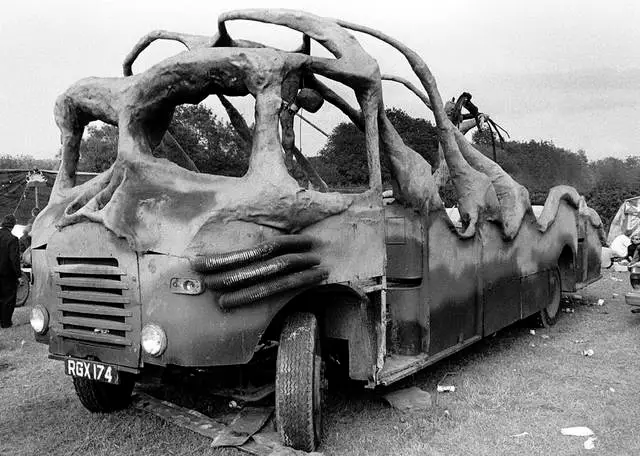
Recognition and Significance of Mutoid Waste Company’s Work
The punk art, dirty realism, and industrial chaos of the Mutoid Waste Company spilled out beyond the confines of traditional galleries and museums. It lived on the streets, in abandoned hangars, and in squats, amongst the people. This collective were pioneers in the transformation of free festivals into a new format — the early rave culture, which seamlessly combined installations, performance art, and a radical visual aesthetic. In a contemporary context, their work is exhibited and showcased at some of the world’s most renowned festivals, such as Glastonbury, Fuji, and Burning Man, captivating the attention of thousands.