


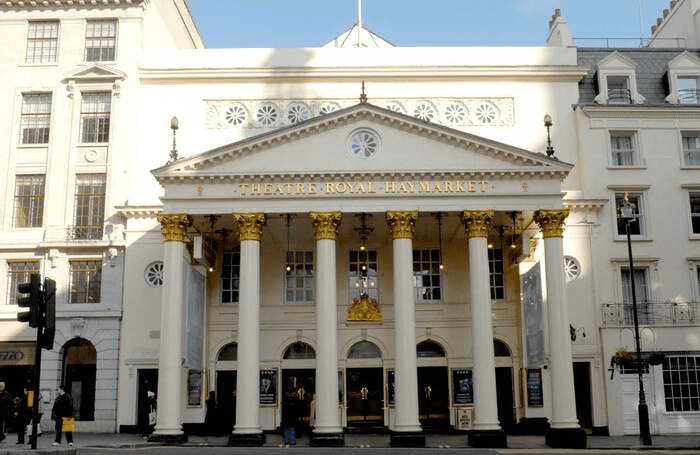
Theatres play an important role in the tourist, cultural, economic, social and artistic life of the capital of Great Britain. There are many theatres in the city and each of them can impress you with incredibly beautiful architecture, professional actors and an eventful history. One of them is the Theatre Royal Haymarket. The institution can boast of the status of the third-oldest theatre in London that is still functioning. It has been impressing visitors with its power and uniqueness for more than 300 years. So, how did this place combine classical theatre traditions and modern unusual trends? Learn more at london-trend.
A SMALL THEATRE IN THE CITY FULL OF CONTRADICTIONS
The Theatre Royal Haymarket is one of the oldest institutions in London. Its history began back in 1720 when the capital of Great Britain was a city of contrasts. It was full of riches and poverty, new inventions and old crafts, fancy garments and simple peasant clothes. At that time, carpenter John Potter built his own small and cosy theatre. The man faced many difficulties from the very beginning. The main problem was the lack of the Royal Charter (permit) to carry out professional activities. John Potter tried his best to prevent the closure of the institution. The situation improved when the French duke opened the theatre with a play La Fille a la Morte, ou le Badeaut de Paris. Although it didn’t become the most popular one, it gave the theatre an official chance to exist. In 1729, the play Hurlothrumbo brought wild success to the place.
In 1737, the theatre faced a number of problems again. The institution was closed until 1741 due to the adoption of the Licensing Act 1737 in Great Britain. It aimed to control everything that was said in a society. The actor Charles Macklin managed to bring success to the theatre again. For a long time, he and his colleagues staged performances, relying on a temporary licence or some tricks. During this period, the actor organised one of the first theatre schools in London, where people studied acting skills on stage.
THE BEGINNING OF THE 20TH CENTURY IN THE HISTORY OF LONDON AND THE THEATRE
By that time, the Theatre Royal Haymarket had undergone many changes. Its owners changed several times, a number of large-scale restorations and renovations were carried out and the stage of the institution saw a lot of talented actors. So, at the beginning of the 20th century, a small and cosy theatre turned into an exquisite building with amazing and enchanting architectural features. The new century was marked by new global events, which were reflected in literature and, in particular, theatre art. In 1909, the institution staged the famous play The Blue Bird. Later, its visitors could watch the Scottish comedy Bunty Pulls the Strings, Ibsen’s legendary play Ghosts as well as famous The Widow’s Might and General Post. The Theatre Royal Haymarket had to endure the terrible events of the war, but despite everything, the institution reopened its doors after the end of the Second World War and showed even more creative diversity.
FROM ESTABLISHED TRADITIONS TO MODERN PROGRESS
Nowadays, the Theatre Royal Haymarket is one of the most popular theatres in London. A large number of tourists want to visit it. Love’s Labour’s Lost, The Goat, or Who is Sylvia and Heathers: The Musical are some of the latest highlights. The institution strives to create unforgettable theatrical experiences for its audiences from all over the world. In 2018, Access Entertainment became the new owner of the theatre. The company aims to continue the rich history of the institution and support both its most outstanding representatives and new talented personalities.