


Every city in the world has its own special locations where you can feel the real atmosphere of this particular corner of our planet. These are natural objects, national monuments, various institutions and ordinary obscure streets hiding incredible stories and legends. Such places exist in London as well. Once you get there, you feel unrepeatable smells, sounds and tastes, as they are unique for each city. All of this relates to the Globe Theatre. This institution reflects the cultural history of London. Here, you will immerse yourself in the times of Shakespeare’s life and his creative activities, learn about the peculiarities of theatrical art of that time and also find many common features with modern theatres. Learn more at london-trend.
THE HISTORY FILLED WITH MYSTERIES
The most interesting fact that encourages many to visit this place is that the theatre is closely associated with the name of one of the world’s most famous playwrights. He played an important role in the development of this institution and made it quite popular in the modern world. However, William Shakespeare was not the only owner of the theatre. Moreover, he owned only 12.5% of the total number of shares. In addition to him, there were five more shareholders. Thus, the theatre offered visitors not only Shakespeare’s productions but also Ben Jonson’s, John Fletcher’s and Thomas Dekker’s.
The theatre was opened in 1599. Later, its original location became the subject of research and controversy, as archaeologists have been trying to find it for many years. Read more about this later in our article. So, the Globe Theatre was built in the centre of London in Southwark, near the River Thames. The theatre’s first performance was Ben Jonson’s satirical comedy play Every Man out of His Humour. Another significant, but, at the same time, sad event happened to the theatre in 1613. That year, the theatre was caught on fire during one of the performances. As a result, it was damaged and restored the following year. The Globe Theatre was quite a popular place for entertainment. Unfortunately, the institution was destroyed by the Puritans in 1644. Such a fate awaited all theatres in London at that time.
AMAZING ARCHITECTURAL SOLUTIONS
The initial architectural ideas of the Globe Theatre were quite interesting. Its round shape resembled an amphitheatre that could accommodate approximately 3,000 spectators. It was made mostly of wood. That was the reason the fire of 1613 spread and destroyed everything around so quickly. The main feature of the theatre was its roof, which covered only the stage. It housed a statue of Hercules holding the globe on his shoulders. The roof was painted blue and resembled the sky. It also featured a hatch through which a person could descend on a rope. In addition, there were two doors beneath that were used by actors entering the stage. You could feel the special atmosphere and spirit of that place reading the inscription above its entrance – “Totus mundus agit histrionem”, which translates as “All the world’s a stage.”
REFLECTION OF ANCIENT IDEAS IN THE MODERN WORLD
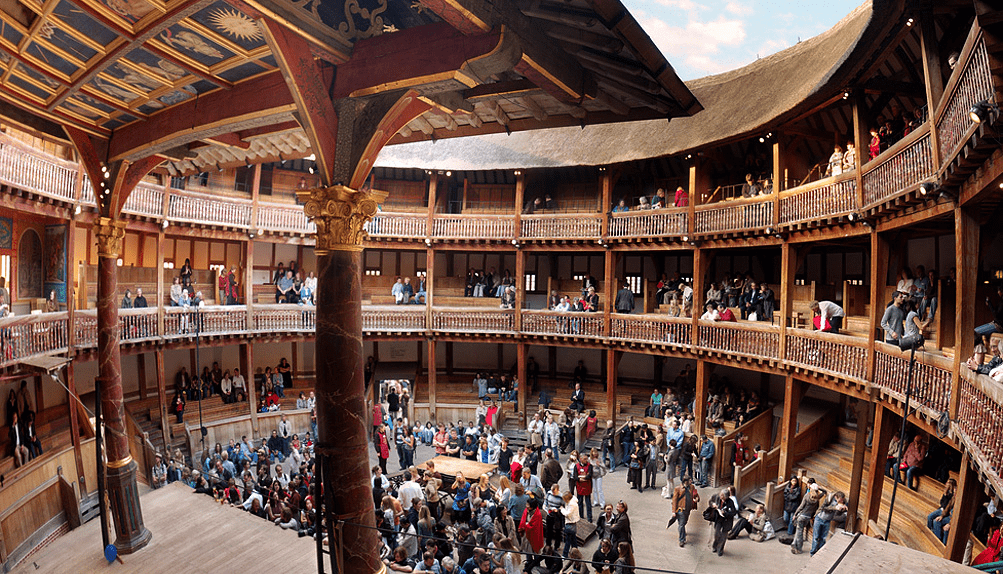
The theatre restoration process was closely related to its historical location, which remained a secret until 1989. That year, archaeologists found the remains of the old theatre’s foundation under Anchor Terrace. However, this building is a historical monument and it’s forbidden to carry out excavations there. Therefore, part of the former theatre building remains unexplored. This adds even more mystery to its history.
The modern theatre, which is open to everyone, was built in 1997 not far from its historical location (about 205 metres). The original ideas were taken as the basis for the creation of the new building. So, the new Globe Theatre can be considered an accurate reproduction of its historical predecessor.